



Amazon marketplace policy news matters more than ever for sellers who want to protect their listings, avoid account issues, and keep profit margins under control. Amazon changes rules around FBA fees, product compliance, advertising, listing quality, returns, and account health throughout the year.
For sellers, the problem is not only that Amazon updates policies. The bigger problem is that many sellers notice the change only after a listing is suppressed, an ad is rejected, inventory is delayed, or their Account Health dashboard shows a warning.
This guide only explains Amazon Marketplace Policy News. You will learn what policy updates usually mean, who they affect, how risky they are, and what action sellers should take next.
Table of Contents
What Is Amazon Marketplace Policy News?
Amazon marketplace policy news refers to updates, rule changes, compliance requirements, fee changes, and enforcement notices that affect sellers on Amazon.
These updates may involve:
- FBA fulfillment fees
- Product safety documentation
- Listing title and image rules
- Account Health requirements
- Sponsored Ads policies
- Brand Registry and IP complaints
- FBM returns and shipping rules
- Seller performance standards
- Product compliance documents
Amazon marketplace policy news is important because Amazon can take action when sellers do not follow its policies. That action may include listing suppression, ad disapproval, inventory restrictions, account warnings, or selling account deactivation.
Quick Summary of Important Amazon Policy Areas
| Policy Area | Seller Risk | Who Is Affected | What Sellers Should Do |
|---|---|---|---|
| Account Health | High | All sellers | Check warnings and fix violations quickly |
| FBA Fees | Medium | FBA sellers | Recalculate profit margins |
| Product Compliance | High | Regulated-category sellers | Keep certificates and documents ready |
| Advertising Rules | Medium | PPC advertisers | Review claims, landing pages, and ad copy |
| Listing Titles | Medium | Catalog and private label sellers | Follow Amazon title rules |
| FBA Prep and Labels | High | FBA sellers | Prepare and label inventory before shipment |
| Brand/IP Rules | High | Brands and resellers | Keep trademark and authorization proof |
This is the best way to understand Amazon marketplace policy news: do not only ask, “What changed?” Also ask, “Does this affect my business, and what should I do now?”
Why Amazon Marketplace Policy News Matters for Sellers
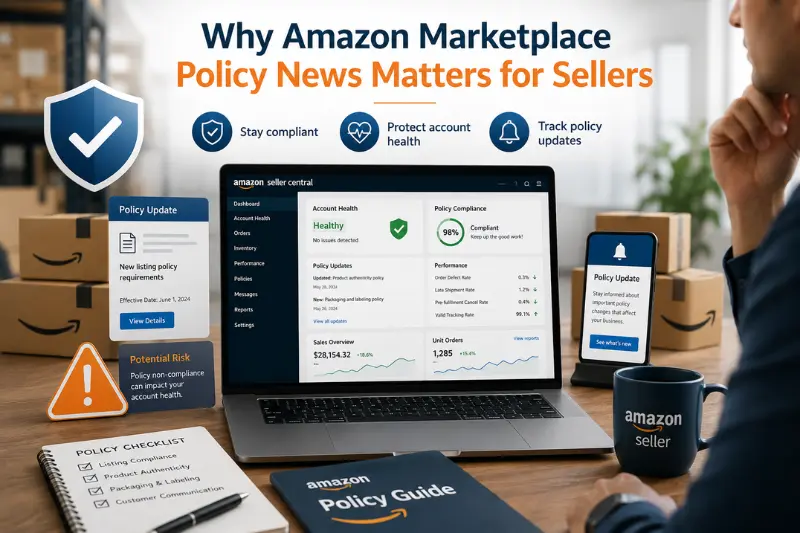
Amazon is a trust-based marketplace. The company wants customers to receive safe products, accurate listings, reliable shipping, and honest advertising. That is why Amazon’s policies are strict.
For sellers, ignoring Amazon marketplace policy news can create problems such as:
- Product detail pages are going inactive
- FBA inventory being delayed or rejected
- Sponsored Ads are being paused
- Product compliance requests
- Account Health Warnings
- Lost Buy Box performance
- Higher fulfillment costs
- More returns and customer complaints
Amazon’s Account Health page gives sellers an overview of whether their account follows the performance targets and policies required to sell in Amazon stores. That means sellers should treat Account Health as a daily or weekly business dashboard, not something to check only after a problem appears.
Latest Amazon Marketplace Policy News Sellers Should Track
Amazon policy updates do not affect every seller in the same way. A private label brand, a reseller, an FBA seller, and a PPC advertiser may all face different risks.
Below are the most important Amazon marketplace policy news categories to watch.
Amazon FBA Fee and Fulfillment Policy Updates
FBA sellers should pay close attention to fulfillment fee changes because even a small fee increase can reduce profit margins.
Amazon announced that starting April 17, 2026, a 3.5% fuel and logistics-related surcharge applies to FBA fulfillment fees in the US. Amazon’s Seller Central notice also says the surcharge applies to FBA in the US and Canada and Remote Fulfillment with FBA from the US into Canada, Mexico, and Brazil. Starting May 2, 2026, the surcharge also applies to Buy with Prime in the US and Multi-Channel Fulfillment in the US and Canada.
What This Means for Sellers
If your products already have thin margins, this update can affect your profit quickly. Sellers should not wait until the next monthly profit report to check the impact.
Seller Action Steps
- Review your FBA fee reports.
- Use Amazon’s Revenue Calculator.
- Recalculate margins for low-priced products.
- Check MCF and Buy with Prime costs.
- Compare FBA vs FBM for products with weak profit margins.
- Adjust pricing only after checking competitor pricing and Buy Box impact.
FBA Prep and Labeling Policy Updates
FBA prep is another important part of Amazon marketplace policy news. Amazon says that starting January 1, 2026, it will no longer offer prep and item labeling services for FBA shipments in the US store.
What This Means for Sellers
Sellers must make sure products arrive at Amazon already prepared and correctly labeled. This is especially important for sellers using suppliers, freight forwarders, or third-party prep centers.
Seller Action Steps
- Confirm prep requirements for every ASIN.
- Make sure FNSKU labels are correct.
- Train your supplier or 3PL on Amazon packaging rules.
- Check your inbound shipment workflow.
- Keep photos or records of prepared shipments.
- Fix repeated prep errors before they become expensive.
This update is especially risky for sellers who previously relied on Amazon to handle prep or labeling after inventory arrived.
Account Health and Compliance Updates
Account Health is one of the most important parts of Amazon marketplace policy news. A seller may have strong sales and still face account risk if policy warnings are ignored.
Amazon’s Account Health page shows whether a selling account is meeting Amazon’s policies and performance targets. It helps sellers monitor policy compliance, customer service performance, and shipping performance.
What Sellers Should Watch
- Policy violations
- Product authenticity complaints
- Intellectual property complaints
- Product safety issues
- Order Defect Rate
- Late Shipment Rate
- Valid Tracking Rate
- Restricted product warnings
Seller Action Steps
- Check Account Health at least weekly.
- Fix small warnings before they grow.
- Do not submit weak appeals.
- Keep invoices and supplier proof ready.
- Save screenshots of notices.
- Track repeat problems by ASIN.
A good seller does not wait for Amazon to send a final warning. The safest approach is to monitor issues early and act before enforcement becomes serious.
Product Compliance and Safety Documentation
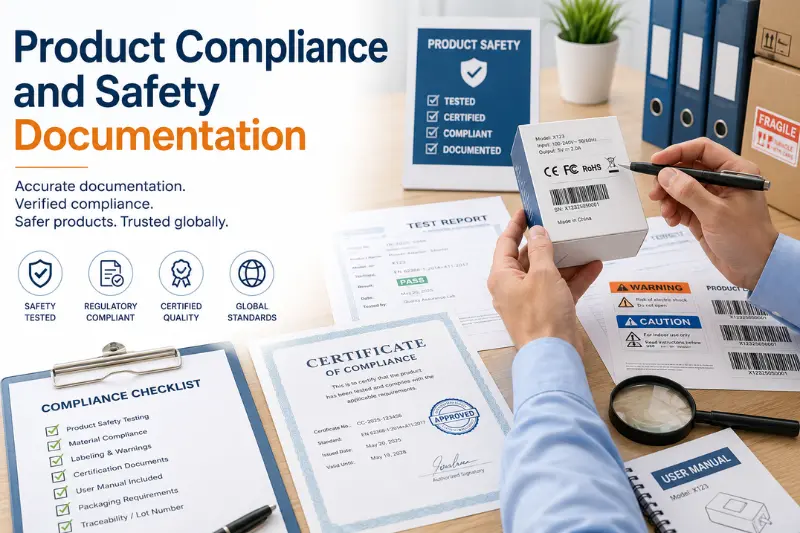
Product compliance is a high-risk area in Amazon marketplace policy news. Amazon requires sellers to follow applicable laws, regulations, standards, and Amazon policies for the products they list. Sellers may need to provide compliance documents when Amazon requests them.
Amazon also states that sellers must be able to demonstrate through valid compliance documentation that products meet regulatory and policy requirements.
Products That Need Extra Attention
- Toys and children’s products
- Electronics
- Health and beauty products
- Supplements
- Food-contact products
- Batteries and chargers
- Medical or wellness-related products
- Products sold in EU marketplaces
Seller Action Steps
- Keep test reports updated.
- Use approved or reliable testing providers.
- Keep supplier invoices organized.
- Store safety certificates in one folder.
- Check compliance requests before listing new products.
- Do not wait until a listing is removed to find documents.
This is one area where sellers should be proactive. If Amazon asks for documents and you do not have them, the listing may lose visibility or become inactive.
Amazon Advertising and PPC Policy Updates
Advertising rules are another key part of Amazon’s marketplace policy news. If you run Sponsored Products, Sponsored Brands, Sponsored Display, or Amazon DSP campaigns, your ads must follow Amazon Ads policies.
Amazon Ads says policies may be updated periodically and advertisers should review the change log for updates. Amazon also says it may suspend or terminate ad accounts for severe or repeated policy violations.
Common PPC Policy Problems
- Unsupported product claims
- Misleading discount language
- Before-and-after claims
- Medical or health claims without proof
- Restricted keywords
- Landing pages that do not match the ad
- Images that exaggerate product results
Seller Action Steps
- Review ad copy before launch.
- Check product claims on the detail page.
- Avoid exaggerated wording.
- Keep claim proof ready.
- Monitor rejected ads.
- Check the Amazon Ads policy change log regularly.
Your PPC team should not only focus on ACoS and ROAS. They should also understand policy compliance because one rejected campaign can delay sales during important periods.
Listing Title and Catalog Policy Updates
Listing quality affects both search visibility and compliance. Amazon has product title requirements that sellers must follow. Amazon’s title guidelines say titles must not use certain special characters such as !, $, ?, _, {, }, ^, ¬, and ¦. Amazon also says some categories may have different requirements.
Amazon also recommends using 80 characters or fewer for titles because long titles may be truncated on mobile screens, even though 200 characters is the maximum allowed in many cases.
What This Means for Sellers
A title that looks optimized to a seller may look spammy or non-compliant to Amazon. Repeating keywords too much can also make a listing harder to trust.
Seller Action Steps
- Keep titles clear and readable.
- Put the main product type early.
- Avoid keyword stuffing.
- Remove unnecessary symbols.
- Check category-specific title rules.
- Keep mobile users in mind.
- Update old listings with cleaner titles.
A good title should help both Amazon and the customer understand the product quickly.
Brand Registry and Intellectual Property Updates
Brand and IP issues are serious because they can affect both listings and account health. This area of Amazon marketplace policy news is especially important for resellers, wholesale sellers, and private label brands.
Who Is Most at Risk?
- Sellers using brand names without authorization
- Resellers without proper invoices
- Sellers using copyrighted images
- Sellers copying competitor bullet points
- Brands with incomplete trademark records
- Sellers listing generic products under branded terms
Seller Action Steps
- Keep brand authorization letters.
- Use your own product images.
- Avoid copying product descriptions.
- Store trademark documents.
- Respond to IP complaints carefully.
- Do not create duplicate or misleading branded listings.
For private label sellers, Brand Registry can help protect listings. For resellers, proper supply chain documentation is essential.
FBM, Returns, and Shipping Policy Updates
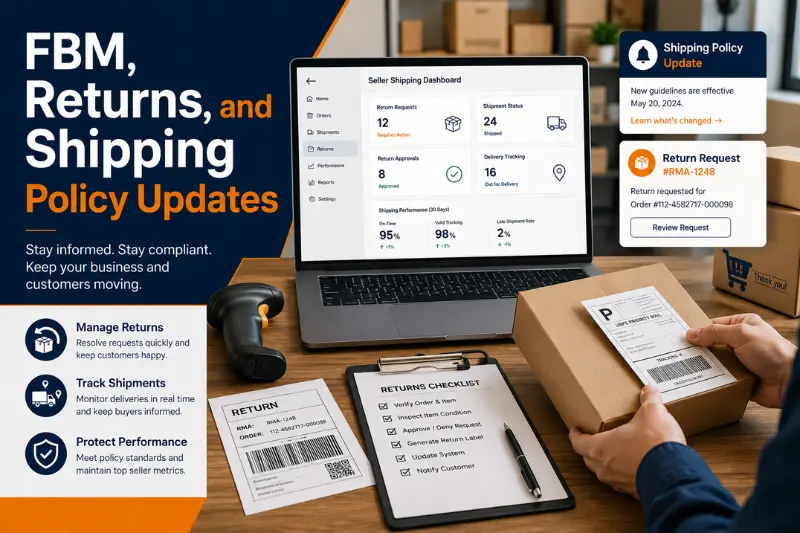
Fulfilled by Merchant sellers must watch shipping and return rules closely. FBM sellers control more of the customer experience, so Amazon expects strong performance.
Key FBM Risk Areas
- Late shipment
- Invalid tracking
- Slow refunds
- Poor return inspection process
- Damaged returned items
- Customer complaints
- Delivery promise issues
Seller Action Steps
- Use reliable carriers.
- Upload valid tracking on time.
- Inspect returns quickly.
- Take photos of damaged returns.
- Keep return records.
- Monitor customer messages.
- Avoid overpromising delivery dates.
FBM sellers should build a simple daily workflow for shipping and returns. Small delays can affect account performance.
Amazon Marketplace Policy Risk Matrix
This risk matrix makes Amazon marketplace policy news easier to understand.
| Policy Update Type | Risk Level | Main Impact | Best Seller Response |
|---|---|---|---|
| Account Health warning | High | Account suspension risk | Fix immediately and document actions |
| Product compliance request | High | Listing removal risk | Submit valid documents quickly |
| FBA fee increase | Medium | Lower profit margin | Recalculate pricing and costs |
| Ad policy rejection | Medium | Lost PPC traffic | Review ad copy and claims |
| Title policy issue | Medium | Listing suppression or lower quality | Clean titles and remove spam |
| FBA prep error | High | Inventory delay or extra cost | Improve supplier and 3PL checks |
| IP complaint | High | Listing or account risk | Provide authorization and invoices |
This section gives your article a stronger unique angle because it helps sellers prioritize action instead of only reading news.
Who Is Most Affected by Amazon Marketplace Policy News?
FBA Sellers
FBA sellers are affected by fee updates, prep rules, storage limits, reimbursement policies, and inventory placement changes. They should review costs every month.
FBM Sellers
FBM sellers are affected by shipping performance, return handling, customer service, and tracking rules. They need strong daily operations.
Private Label Brands
Private label sellers must watch Brand Registry, listing quality, image rules, product compliance, and ad policies. They should maintain clean brand assets and product documents.
Wholesale Sellers
Wholesale sellers need proper invoices, supplier proof, and brand authorization. They should avoid weak sourcing that cannot pass Amazon verification.
Retail Arbitrage Sellers
Retail arbitrage sellers face higher documentation risk. Retail receipts may not always satisfy Amazon when authenticity or supply chain proof is requested.
PPC Advertisers
Advertisers must follow Amazon Ads policies, review claims, and monitor rejected campaigns. Policy issues can reduce traffic during key sales periods.
EU and International Sellers
International sellers must watch regional compliance rules, safety documents, responsible person requirements, VAT, and local marketplace policies.
What to Do When You See a New Amazon Policy Update
When you read Amazon marketplace policy news, do not panic. Use a simple process.
Step 1: Identify the Policy Area
Ask yourself:
- Is this about FBA?
- Is it about account health?
- Is it about advertising?
- Is it about product compliance?
- Is it about listings or catalog quality?
Step 2: Check Whether It Applies to You
Not every update affects every seller. A PPC policy may not matter if you do not run ads. A European compliance update may not matter if you sell only in the US.
Step 3: Find the Risk Level
Use this simple rule:
- High risk: Can affect account, listings, compliance, or payouts.
- Medium risk: Can affect ads, fees, conversion, or inventory.
- Low risk: Requires monitoring but does not need urgent action.
Step 4: Take Action Before Enforcement
Do not wait for Amazon to detect a problem. Update listings, documents, campaigns, or inventory workflows early.
Step 5: Keep Proof
Save:
- Invoices
- Certificates
- Email confirmations
- Supplier agreements
- Shipment records
- Screenshots of policy notices
- Appeal responses
Good records can make a big difference when you need to respond to Amazon.
Documents Every Amazon Seller Should Keep Ready
A strong document system helps sellers respond faster to Amazon marketplace policy news and compliance requests.
Keep these documents organized:
- Supplier invoices
- Brand authorization letters
- Product safety certificates
- Testing reports
- Trademark documents
- FNSKU and shipment records
- Product photos
- Packaging proof
- Return inspection photos
- PPC claim proof
- Insurance documents, where required
Do not keep these documents scattered across emails, WhatsApp chats, and supplier messages. Create a proper folder system by brand, ASIN, and marketplace.
Where to Verify Amazon Marketplace Policy News
Sellers should not rely only on social media posts, Facebook groups, or third-party blogs. Always verify important Amazon marketplace policy news from official Amazon sources.
Check these places:
- Seller Central announcements
- Account Health dashboard
- Amazon Ads policy pages
- FBA fee pages
- Policy Compliance dashboard
- Amazon Seller Forums
- Amazon Brand Registry messages
- Amazon Ads console notifications
This protects you from acting on outdated or incomplete information.
Common Mistakes Sellers Make With Amazon Policy Updates
Ignoring Small Warnings
A small warning can become a larger issue if ignored. Fix it early.
Waiting Until a Listing Is Removed
If a product needs compliance documents, prepare them before Amazon asks.
Updating Listings Too Aggressively
Do not change titles, bullets, images, and backend keywords all at once without checking policy rules.
Using Unsupported Claims
Words like “best,” “guaranteed,” “cure,” “safe for everyone,” or “clinically proven” can create problems if you cannot support them.
Not Checking Profit After Fee Changes
Fee updates can quietly reduce profit. Sellers should review margins after every major FBA fee change.
Depending on One Source
Always verify important Amazon marketplace policy news through Seller Central or official Amazon pages.
Final Amazon Seller Compliance Checklist
Use this checklist once a week:
- Check Account Health.
- Review new Seller Central announcements.
- Check rejected ads.
- Review FBA fee changes.
- Audit top-selling listings.
- Check product compliance requests.
- Review return problems.
- Confirm supplier documents are saved.
- Monitor IP complaints.
- Recalculate margins on low-profit ASINs.
This simple weekly routine can help sellers avoid many avoidable problems.
Final Thoughts
Amazon marketplace policy news is not just something sellers should read occasionally. It should be part of your weekly business routine.
The safest sellers are not always the biggest sellers. They are the sellers who notice changes early, understand the risk, keep documents ready, and take action before Amazon enforcement begins.
If you sell on Amazon, build a simple system: check official updates, review Account Health, monitor FBA costs, audit your listings, and keep your compliance documents organized. This habit can protect your account, improve operations, and help you stay ready for the next Amazon marketplace policy news update.
FAQs
What is Amazon Marketplace policy news?
Amazon marketplace policy news means updates, rule changes, fee changes, and compliance notices that affect Amazon sellers. These updates may involve FBA, listings, ads, Account Health, shipping, returns, product safety, or Brand Registry.
Why should sellers follow Amazon Marketplace policy news?
Sellers should follow Amazon Marketplace policy news because policy changes can affect listings, ads, inventory, account health, and profits. Staying updated helps sellers fix issues before Amazon takes action.
Where can I find official Amazon seller policy updates?
You can check Seller Central announcements, the Account Health dashboard, Amazon Ads policy pages, FBA fee pages, Seller Forums, and Brand Registry messages.
How often does Amazon update seller policies?
Amazon updates seller policies throughout the year. Some updates are small, while others can affect fees, compliance documents, listings, or advertising rules.
Can Amazon suspend an account for policy violations?
Yes. Serious or repeated policy violations can lead to listing removal, account warnings, advertising restrictions, or account deactivation.
What is the most important Amazon policy area to monitor?
Account Health is one of the most important areas because it shows whether your selling account is following Amazon’s policies and performance targets.
Do FBA fee updates affect all sellers?
No. FBA fee updates mainly affect sellers using Fulfillment by Amazon. However, related updates may also affect Multi-Channel Fulfillment and Buy with Prime sellers.
How can sellers prepare for product compliance requests?
Sellers should keep invoices, safety certificates, test reports, supplier details, and product documents ready before Amazon requests them.
What should sellers do after reading the new Amazon marketplace policy news?
They should check whether the update applies to their business, review the risk level, update their process, and save proof of any corrective action.
Is every Amazon policy update urgent?
No. Some updates are informational, while others require immediate action. Sellers should prioritize updates that affect account health, product compliance, FBA inventory, and payouts.
YOU MAY ALSO LIKE:
iGame News eTrueSports – Updates, Codes And Trends
7 Proven Business Description Editing Guidelines
