



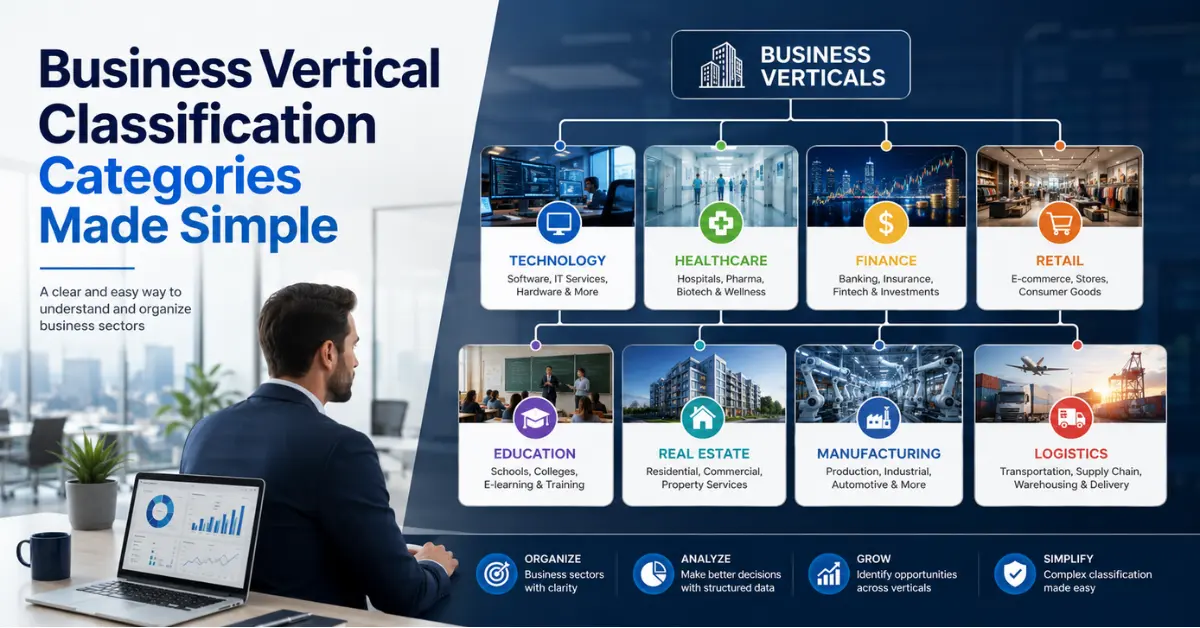
Understanding business vertical classification categories helps companies describe what they do, who they serve, and where they fit in the market. Whether you run a small business, SaaS company, agency, eCommerce store, healthcare practice, or financial service, your Business vertical affects your marketing, competition, compliance, pricing, and growth strategy.
In simple words, business vertical classification categories are organized groups that separate businesses by industry, customer type, products, services, and market purpose.
For example, a hospital belongs to the healthcare vertical. An online clothing store belongs to the retail or e-commerce vertical. A company that builds accounting software for all industries may be horizontal, but accounting software made only for hospitals is part of a healthcare technology sub-vertical.
This guide explains business verticals in a simple, practical, and easy-to-understand way.
Table of Contents
What Are Business Vertical Classification Categories?
Business vertical classification categories are systems used to group businesses into specific industry lanes. These categories help people understand what a company does and which market it serves.
A business vertical is not just a label. It gives direction to your:
- Marketing strategy
- Target audience
- Competitor research
- Pricing model
- Compliance requirements
- Sales process
- Investment positioning
- SEO and content strategy
For example, a company selling cybersecurity software to banks is not simply a “software company.” It operates in the financial technology and cybersecurity vertical because its customers, risks, language, and regulations are specific to finance.
Simple Definition of a Business Vertical
A business vertical is a specific industry or market category where companies serve similar customers with similar needs.
Examples of common business verticals include:
- Healthcare
- Finance
- Technology
- Retail
- Education
- Manufacturing
- Real estate
- Transportation
- Energy
- Media and entertainment
The purpose of business vertical classification categories is to make the business world easier to organize, compare, and understand.
Business Vertical vs Horizontal Market
Many people confuse vertical markets with horizontal markets. The difference is simple.
| Point | Vertical Market | Horizontal Market |
|---|---|---|
| Focus | One specific industry | Many industries |
| Audience | Narrow and targeted | Broad and general |
| Product style | Specialized | General-purpose |
| Marketing message | Industry-specific | Wider and less specific |
| Example | Hospital billing software | General accounting software |
A vertical business focuses deeply on one industry. A horizontal business serves many industries with the same type of product or service.
For example, a CRM made only for real estate agents is vertical. A CRM used by restaurants, agencies, doctors, and retailers is horizontal.
Why Business Vertical Classification Categories Matter

The right classification helps a business understand where it belongs and how it should compete. Without clear classification, companies often target the wrong audience, compare themselves with the wrong competitors, or use weak marketing messages.
Here is why business vertical classification categories matter:
They improve market positioning
When your business clearly belongs to a vertical, customers understand your value faster. A “marketing agency for dentists” sounds more specific than a “digital marketing agency.”
They make competitor research easier
You cannot study your competitors correctly unless you know your real vertical. A small software company serving clinics should compare itself with healthcare software providers, not every software company.
They support better SEO planning
Search engines understand topical relevance. When your website focuses on one clear vertical, your content clusters, keywords, internal links, and authority become stronger.
They help with funding and investment
Investors compare companies by sector, industry, and business model. A fintech startup, retail brand, and construction company are valued differently because each vertical has different risks and growth patterns.
They reduce compliance mistakes
Different verticals follow different rules. Healthcare may involve patient privacy rules. Finance may involve banking or investment regulations. Education may involve accreditation and student data policies.
Sector vs Industry vs Vertical vs Niche
These words are often used together, but they are not exactly the same.
| Term | Meaning | Example |
|---|---|---|
| Sector | A broad part of the economy | Healthcare |
| Industry | A more specific business activity | Medical devices |
| Vertical | A market-focused category | Healthcare technology |
| Sub-vertical | A smaller specialized area | Telemedicine for rural clinics |
| Niche | A highly focused audience or need | Appointment software for pediatric clinics |
This is where many businesses make mistakes. They choose a broad label like “technology” when their real opportunity is much more specific, such as “AI software for insurance claims.”
Major Business Classification Systems
Formal classification systems help governments, investors, researchers, and companies organize businesses in a consistent way.
NAICS
NAICS stands for North American Industry Classification System. It is used by federal statistical agencies to classify business establishments for collecting, analyzing, and publishing business economy data. It was developed to improve comparability among the United States, Canada, and Mexico.
NAICS uses codes to organize businesses by economic activity. The system moves from broad sectors to more specific industries.
Example:
| Code Level | Meaning |
|---|---|
| 2-digit | Sector |
| 3-digit | Subsector |
| 4-digit | Industry group |
| 5-digit | NAICS industry |
| 6-digit | National industry |
NAICS is useful for business registration, government research, industry analysis, and contract classification.
SIC
SIC stands for Standard Industrial Classification. It is an older industry classification system. NAICS replaced SIC for many modern statistical purposes, but SIC codes still appear in older databases, banking systems, and legacy business records. The Bureau of Labor Statistics notes that NAICS was redesigned and recognizes hundreds more businesses than SIC, especially in fast-growing service industries.
GICS
GICS stands for Global Industry Classification Standard. It is commonly used in investment research and financial markets. MSCI explains that GICS is a four-tiered system made of sectors, industry groups, industries, and sub-industries, and companies are classified by principal business activity.
S&P Global also describes GICS as a system with 11 sectors, followed by industry groups, industries, and sub-industries.
ICB
ICB stands for Industry Classification Benchmark. It is another classification system used in financial markets, especially for comparing listed companies and investment sectors.
NACE
NACE is used in Europe for economic activity classification. It helps organize businesses for statistical, regulatory, and reporting purposes across European markets.
Core Business Vertical Classification Categories
Below are the most common business vertical classification categories used across modern markets.
| Business Vertical | What It Includes | Example Businesses |
|---|---|---|
| Technology | Software, AI, cloud, cybersecurity, hardware | SaaS tools, IT services, AI platforms |
| Healthcare | Hospitals, clinics, pharma, medical devices | Clinics, telehealth apps, biotech firms |
| Financial Services | Banking, insurance, payments, investment | Banks, fintech apps, payment gateways |
| Retail and eCommerce | Online stores, physical stores, consumer goods | Fashion stores, marketplaces, DTC brands |
| Manufacturing | Production, machinery, industrial goods | Auto parts, electronics, factories |
| Real Estate | Property, construction, rental, proptech | Realtors, builders, property platforms |
| Education | Schools, online learning, training | Universities, LMS platforms, tutors |
| Energy and Utilities | Oil, gas, electricity, solar, water | Utility firms, solar providers |
| Transportation | Freight, logistics, delivery, aviation | Courier companies, trucking firms |
| Media and Entertainment | Publishing, streaming, gaming, events | News sites, gaming studios, creators |
| Agriculture and Food | Farming, food production, agri-tech | Farms, food processors, agri software |
| Professional Services | Legal, consulting, accounting, agencies | Law firms, SEO agencies, consultants |
These business vertical classification categories are broad. Each one can be divided into smaller sub-verticals.
Examples of Sub-Verticals
Sub-verticals make classification more accurate. They help businesses target a specific part of a broad market.
Healthcare sub-verticals
- Telemedicine
- Dental care
- Medical billing
- Mental health services
- Pharmaceutical manufacturing
- Health insurance technology
Finance sub-verticals
- Digital banking
- Payment processing
- Personal finance apps
- Insurance technology
- Wealth management
- Crypto and blockchain finance
Technology sub-verticals
- SaaS
- Cybersecurity
- Artificial intelligence
- Cloud hosting
- Data analytics
- Developer tools
Retail sub-verticals
- Fashion eCommerce
- Grocery delivery
- Beauty products
- Consumer electronics
- Subscription boxes
- Luxury retail
This is why a business should not stop at a broad label. “Retail” is useful, but “organic skincare eCommerce for sensitive skin” is much more powerful.
How to Find Your Business Vertical
Choosing the right vertical is not guesswork. You can identify it with a simple process.
1. Look at your main revenue source
Ask yourself: where does most of your money come from?
If 80% of your revenue comes from real estate clients, your business is probably in the real estate vertical, even if you offer a digital service.
2. Study your best customers
Your best customers often reveal your real vertical. Look at who pays the most, stays the longest, and gets the best results from your product or service.
3. Identify the problem you solve
A business vertical is often connected to the problem you solve. For example, a software company solving appointment problems for doctors is closer to healthcare technology than general software.
4. Check your competitors
Your real competitors are the businesses your customers compare you with before buying. If customers compare you with healthcare platforms, you are likely in a healthcare-related vertical.
5. Match your business with a classification system
Use formal systems like NAICS or GICS if you need official classification for reporting, investment, contracts, or research.
6. Review your classification regularly
Your business may change over time. A company that started as an online store may later become a logistics platform. Your vertical should match your current business model, not only your original idea.
Business Vertical Examples by Company Type
Here are practical examples to make business vertical classification categories easier to understand.
| Company Type | Possible Vertical | More Specific Sub-Vertical |
|---|---|---|
| Online clothing store | Retail | Fashion eCommerce |
| SEO agency for dentists | Professional services | Healthcare marketing |
| App for school management | Education | EdTech SaaS |
| Payment app | Financial services | Fintech payments |
| Solar panel installer | Energy | Renewable energy |
| Real estate CRM | Real estate | PropTech software |
| Food delivery platform | Transportation / Food | Last-mile food delivery |
| AI writing tool for lawyers | Technology / Legal | LegalTech AI |
A company can sometimes belong to more than one vertical. In that case, the main vertical is usually the one connected to its primary customer, revenue, or use case.
Emerging Business Vertical Classification Categories

Modern markets are changing quickly. New hybrid verticals combine two or more traditional industries.
FinTech
FinTech combines finance and technology. Examples include mobile banking apps, payment gateways, investment platforms, and lending software.
HealthTech
HealthTech combines healthcare and technology. Examples include telemedicine platforms, health monitoring apps, and AI diagnostic tools.
EdTech
EdTech combines education and technology. Examples include learning apps, online course platforms, student management systems, and digital classrooms.
PropTech
PropTech combines property and technology. Examples include real estate listing platforms, property management software, and virtual home tour tools.
AgriTech
AgriTech combines agriculture and technology. Examples include smart irrigation, crop monitoring tools, farming drones, and supply chain software.
LegalTech
LegalTech combines legal services and technology. Examples include contract automation, legal research tools, and case management software.
These hybrid areas are important because they show how business vertical classification categories are no longer fixed boxes. Many modern companies operate across connected verticals.
Common Classification Mistakes to Avoid
Many businesses choose the wrong category because they focus on the wrong thing.
Choosing by product instead of customer
A company may build software, but if that software only serves banks, the company has a finance-focused vertical.
Using a category that is too broad
“Technology” is often too broad. “Cybersecurity for healthcare providers” is clearer and more useful.
Ignoring revenue
Your main revenue source matters. If most revenue comes from logistics clients, your vertical should reflect logistics.
Copying competitors blindly
Two companies may offer similar products but serve different markets. Always classify based on your own audience and business model.
Never updating the classification
Businesses evolve. Your category should change when your customers, services, or revenue model change.
How Business Vertical Classification Helps SEO
For SEO, business vertical classification categories can improve topical authority and keyword targeting.
If Google sees that your website consistently covers one vertical in depth, it can better understand your expertise. This helps you build stronger content clusters.
For example, a website in the finance vertical may create clusters around:
- Personal finance
- Banking
- Credit cards
- Loans
- Insurance
- Digital payments
- Investment basics
A healthcare website may create clusters around:
- Symptoms
- Treatments
- Medical services
- Patient guides
- Health insurance
- Preventive care
Clear vertical classification also helps with internal linking. You can connect related articles, build category pages, and guide users through the topic naturally.
How Business Vertical Classification Helps Marketing
Marketing becomes easier when you know your vertical.
A generic message says:
“We help businesses grow online.”
A vertical-specific message says:
“We help dental clinics attract more local patients through SEO and Google Business Profile optimization.”
The second message is stronger because it speaks directly to a specific audience.
Vertical marketing improves:
- Ad targeting
- Landing page copy
- Email campaigns
- Sales scripts
- Case studies
- Customer trust
- Conversion rates
People trust businesses that understand their industry language and problems.
How Business Vertical Classification Helps Business Strategy
Good strategy starts with clarity. When a business knows its vertical, it can make better decisions.
It can answer questions like:
- Who are our real customers?
- Who are our direct competitors?
- What problems matter most in this market?
- Which regulations affect us?
- Which keywords should we target?
- Which partnerships make sense?
- What pricing model fits this market?
This is why business vertical classification categories are not only useful for big companies. Small businesses, startups, agencies, bloggers, and local service providers can also use them to grow smarter.
Best Practices for Choosing the Right Business Vertical
Use these best practices to classify your business correctly:
- Start with your customer, not your product.
- Choose a category specific enough to guide strategy.
- Use sub-verticals when a broad vertical is too general.
- Check formal classification systems when needed.
- Study where your competitors and customers already belong.
- Review your vertical when your business model changes.
- Keep your website, content, and branding aligned with your vertical.
The goal is not to sound big. The goal is to sound clear.
Quick Checklist: What Is Your Business Vertical?
Use this simple checklist:
- What industry do most of your customers belong to?
- What problem do you solve for them?
- What type of companies do you compete with?
- What category would customers search for on Google?
- What industry rules or standards affect your work?
- What category generates most of your revenue?
- Can your vertical be made more specific with a sub-vertical?
If you can answer these questions clearly, you are close to finding your correct business vertical.
Final Thoughts
Business vertical classification categories give businesses a clearer way to understand their market, customers, competitors, and growth direction. They help companies avoid vague positioning and build stronger strategies around a specific industry or audience.
The best businesses do not try to serve everyone. They understand their vertical, speak the language of their customers, and solve problems with focus.
Whether you are starting a company, improving your SEO, planning a marketing campaign, or analyzing competitors, the right business vertical gives you clarity. And in business, clarity is a serious advantage.
FAQs
What are business vertical classification categories?
Business vertical classification categories are organized groups used to classify companies by industry, customer type, market function, and business activity. They help businesses, investors, marketers, and regulators understand where a company fits in the economy.
What is an example of a business vertical?
Healthcare is a business vertical. Hospitals, clinics, medical device companies, health insurance providers, and telemedicine platforms all belong to the broader healthcare vertical.
What is the difference between a vertical and an industry?
An industry usually describes business activity, while a vertical often describes the market or customer group a business serves. In everyday use, the terms can overlap, but vertical is more customer-focused.
Can a business have more than one vertical?
Yes. A company can operate in multiple verticals. For example, a large marketplace may operate in retail, logistics, technology, and digital advertising at the same time.
Why are business vertical classification categories important for SEO?
They help organize content around a clear topic area. When your website focuses on one vertical, it becomes easier to build topical authority, create keyword clusters, and improve internal linking.
What is the difference between vertical and horizontal markets?
A vertical market focuses on one industry or customer type. A horizontal market serves many industries with a general product or service.
How do I choose my business vertical?
Start by looking at your main customers, revenue source, competitors, and the problem you solve. Then match your business with the most accurate broad vertical and sub-vertical.
Are business verticals the same in every country?
Not always. The general idea is similar, but formal systems can differ. North America commonly uses NAICS, Europe uses NACE, and financial markets often use GICS or ICB.
YOU MAY ALSO LIKE:
Seller Compliance Guide to Amazon Marketplace Policy News
Pedrovazpaulo Business Consultant – Smart Growth Blueprint
