


Most school administrators, librarians, and IT directors don’t fill out a demo request and buy software the next week. They download a checklist, attend a webinar six months later, get looped into a budget committee, and then sign a contract, sometimes 18 months after first touching your content.
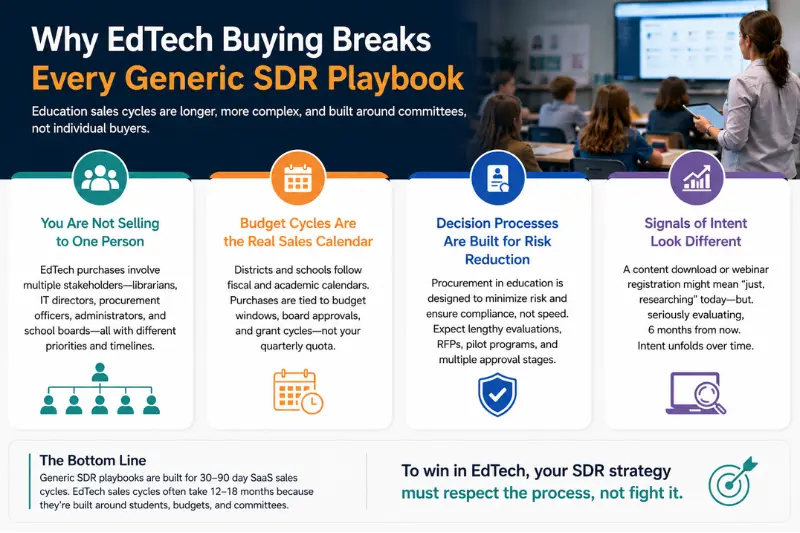
That’s the core reason generic inbound-to-SDR playbooks fail in EdTech: they’re built for 30-day SaaS sales cycles, not 12-month district procurement processes.
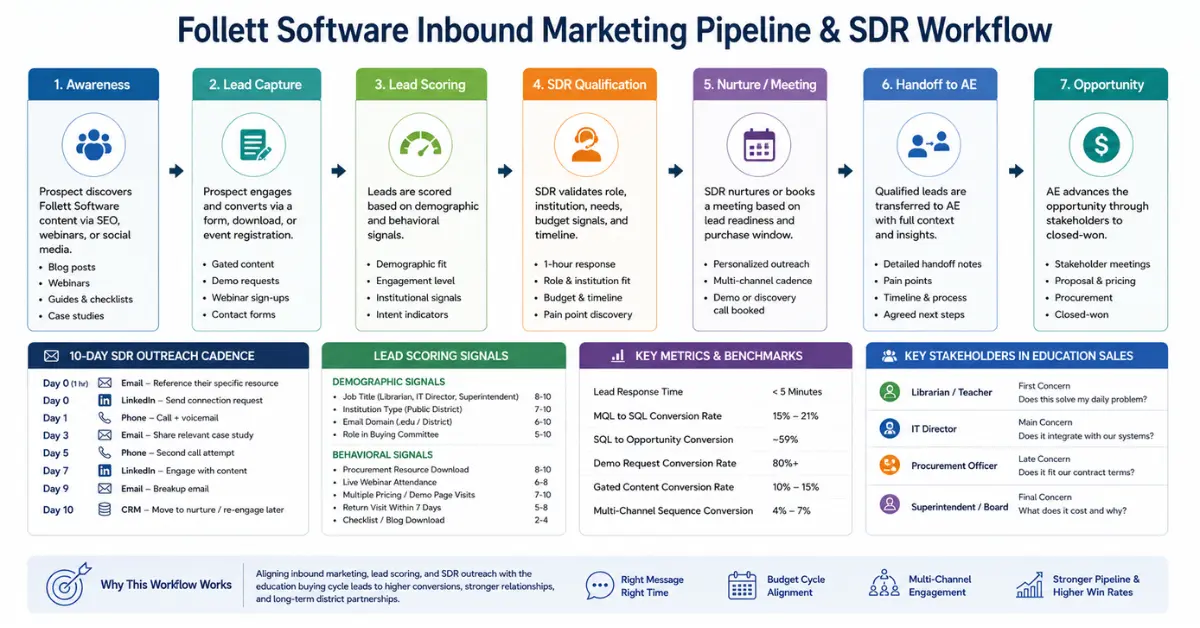
This guide breaks down the full Follett Software inbound marketing pipeline conversion SDR workflow – the actual stage-by-stage mechanics, a day-by-day outreach cadence designed for long-cycle education sales, lead scoring signals built for institutional buyers, and the specific breakdown points that silently kill conversions before they reach an Account Executive.
Who this is for: SDR managers, demand gen leads, and RevOps teams at education software companies who are tired of watching MQLs die in CRM queues.
Table of Contents
What This Workflow Is and What Makes It Different
The Follett Software inbound SDR workflow connects three systems that must work together:
Inbound marketing brings in SEO content, webinars, and gated resources that attract librarians, IT directors, and district administrators. Lead scoring and qualification filters genuine buyers from researchers, vendors, and students. SDR outreach is the human follow-up timed to the prospect’s buying stage, not the company’s urgency.
When these three are misaligned, leads stall. MQLs pile up. SDRs chase the wrong people at the wrong time. When they’re aligned, you get a pipeline that compounds – because EdTech is a referral-heavy, relationship-driven market where a well-timed call from an SDR becomes a 5-year district contract.
Why EdTech Buying Breaks Every Generic SDR Playbook
This is the section most content on this topic skips – and skipping it is exactly why most EdTech SDR programs underperform.
You Are Not Selling to One Person. You Are Selling to a Committee.
A typical B2B SaaS deal has one decision-maker. A Follett Software-style deal involves a chain of approvers, each with different concerns and different timelines:
| Stakeholder | Their First Concern | Enters the Process When |
|---|---|---|
| Librarian / Teacher | Does this solve my daily problem? | First — often the original lead |
| IT Director | Does it integrate with our systems? | Mid-funnel, after librarian advocates |
| Procurement Officer | Does it fit our contract terms? | Late-stage, after IT signs off |
| Superintendent / Board | What does this cost and why? | Final approval stage |
The moment a lead enters your CRM, your SDR’s first job is to identify which of these personas just converted – because the opener, the urgency, and the next step are completely different for each one. A librarian who downloaded a Library Collection Audit Checklist needs a conversation about workflow pain. A procurement officer who clicked through from a district newsletter needs contract and pricing language from the start.
Budget Cycles Are the Real Sales Calendar
School districts typically plan technology purchases around two hard deadlines: the end of the academic year (often April through June) and the start of the fiscal year (July or August in most U.S. districts). E-rate applications add another procurement layer with their own windows.
An SDR workflow that treats every March lead as “buy this quarter” will burn out relationships before the actual budget window opens in September. The fix is not slowing down — it’s matching cadence intensity to purchase window, not just to lead score.
Form Fill Type Signals Intent More Than the Fill Itself
A “Request a Demo” submission from a district procurement email address is a completely different buying signal than “Download our Library Management Checklist” from a personal Gmail. Most generic frameworks score both as equal MQLs. In EdTech, that is a two-to-three tier difference in follow-up urgency.
The Full Pipeline: Stage-by-Stage SDR Actions
| Stage | What Happens | SDR’s Specific Role |
|---|---|---|
| Awareness | Prospect finds content via SEO, LinkedIn, or a webinar | None — marketing owns this stage |
| Lead Capture | Form submission: gated content, demo request, event registration | Lead enters CRM, tagged by source and content type |
| Lead Scoring | Behavioral and demographic scoring runs automatically | SDR reviews score plus job title and institution type |
| Qualification | SDR validates role, institution, and budget signals | First outreach begins within 1 hour for high-intent leads |
| Nurture or Meeting | Demo booked or lead routed to long-term nurture sequence | SDR books meeting or sets calendar-based future follow-up |
| Handoff to AE | Qualified lead transferred to Account Executive | SDR writes context notes: role, concerns, timeline, budget signals |
The handoff note at the final stage is where most teams leak value. An AE who starts from zero with a lead the SDR already warmed up for 10 days will undo that relationship equity in the first five minutes of a call.
The 10-Day SDR Outreach Cadence for Long-Cycle EdTech Sales
Speed matters but so does relevance. Research on B2B pipeline response rates consistently shows that leads contacted within 5 minutes convert at roughly 2.6 times the rate of leads reached after 24 hours. Yet the average B2B company takes close to 47 hours to make first contact.
For EdTech inbound leads, use this 10-day multi-channel cadence:
| Day | Channel | What to Do |
|---|---|---|
| Day 0 within 1 hour | Reference the exact resource they downloaded. Do not use a generic “Thanks for your interest” opener. | |
| Day 0 | Connection request with a one-sentence note tying their role to the resource topic | |
| Day 1 | Phone | First call plus voicemail. Mention the resource by name. Keep it under 25 seconds. |
| Day 3 | Share a relevant case study matching their institution type: public district, private school, or library system | |
| Day 5 | Phone | Second call at a different time of day. If no voicemail was left on Day 1, leave one now. |
| Day 7 | Soft engagement — comment on their recent post or share district-relevant content | |
| Day 9 | “Should I close your file?” breakup email. Short, non-pushy, opens a re-engagement door. | |
| Day 10 | CRM | Move to long-term nurture. Set a calendar-triggered re-engagement for 60 to 90 days out. |
Email-only sequences convert at 1 to 3 percent. Adding phone and LinkedIn brings that to 4 to 7 percent — roughly two to four times better — because it mirrors how district administrators actually communicate. They do not live in their inboxes.
For leads whose budget window is clearly months away, compress the Day 0 through Day 5 outreach to establish the relationship, then space the rest over 30 to 45 days rather than 10. Urgency that does not match the prospect’s timeline reads as ignorance.
Lead Scoring Built for Institutional Buyers, Not SaaS Startups
Generic lead scoring models reward things like “visited the pricing page” or “company size over 500 employees.” Neither maps cleanly to a school district buyer. Use this adapted model instead.
Demographic Signals
| Signal | Score Weight | Why It Matters |
|---|---|---|
| Job title: Librarian, IT Director, Curriculum Director | High | These are the early champions who influence upward |
| Job title: Superintendent, Business Administrator | Very High | These are final approvers — rare early, critical late |
| Email domain: .edu or verified district domain | High | Indicates institutional affiliation, not casual browsing |
| Email domain: personal Gmail or Yahoo | Low | May be a student, vendor, or researcher — not a buyer |
| Institution type: public school district | High | Core Follett buyer segment |
| Institution type: single-school private | Medium | Smaller deal size, shorter cycle |
Behavioral Signals
| Signal | Score Weight | Why It Matters |
|---|---|---|
| Downloaded a procurement resource such as an RFP template or budget guide | Very High | Late-stage intent — they are actively in a buying process |
| Attended a live webinar versus watching a recording | High | Live attendance signals active evaluation, not archival research |
| Visited demo request or pricing pages two or more times | Very High | Multi-visit returning signals strong purchase intent |
| Returned to site within 7 days of first visit | High | Active evaluation cycle underway |
| Downloaded early-stage content like a checklist or blog post PDF | Low to Medium | Awareness stage — nurture, do not rush |
Assign each signal a 1 to 10 point value. Trigger SDR outreach at 50 to 60 combined points. Below that, run automated nurture. Above 75, prioritize outreach within 30 minutes.
Benchmarks to Measure Your Pipeline Against
| Metric | Industry Average | Best-in-Class Target |
|---|---|---|
| Lead response time | Around 47 hours | Under 5 minutes for high-intent leads |
| MQL to SQL conversion rate | 10 to 15 percent | 15 to 21 percent |
| SQL to opportunity conversion | Around 20 percent | Around 59 percent for top-performing SDR teams |
| Demo request conversion rate | 75 to 80 percent | 80 percent or more with personalized pre-demo outreach |
| Gated content download conversion | 5 to 10 percent | 10 to 15 percent with proper nurture sequences |
| Multi-channel sequence conversion | 4 to 7 percent | 7 percent or more with persona-specific messaging |
Education software companies often see lower MQL-to-SQL rates in Q1 and Q2 when district budgets are locked, and higher rates in Q3 and Q4 when new budgets open. If your numbers dip in spring, check whether it is a budget cycle effect before rebuilding your scoring model.
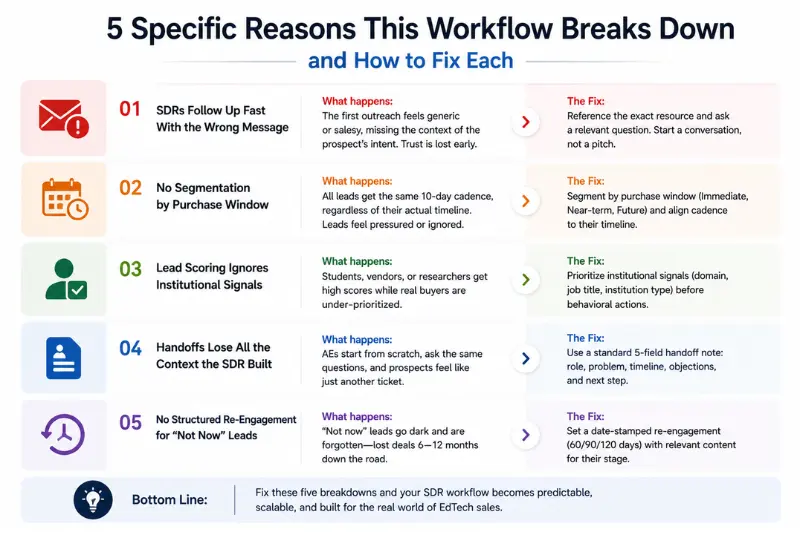
5 Specific Reasons This Workflow Breaks Down and How to Fix Each
SDRs Follow Up Fast With the Wrong Message
What happens: A lead downloads a Library Management Checklist. The SDR calls within an hour with a pricing script. The prospect feels surveilled, not served, and the trust needed for a long-cycle sale evaporates in the first 30 seconds. The fix is making the first touch reference the specific resource and open with a question about the prospect’s situation — not a pitch. “I saw you grabbed our collection audit checklist – are you mid-evaluation, or still in early research mode?” is a far better opener than “I wanted to reach out about Follett’s solutions.”
No Segmentation by Purchase Window
What happens: Every MQL gets the same 10-day urgent cadence regardless of their actual timeline. “Ready this quarter” leads need acceleration. “Planning for next year” leads need relationship-building. Both get the same script and both disengage for different reasons. The fix is adding a “purchase window” tag to your CRM scoring – Immediate at 0 to 90 days, Near-term at 90 to 180 days, Future at 180 or more days – and building three separate nurture tracks.
Lead Scoring Ignores Institutional Signals
What happens: A form fill from a student researching Follett for a class project scores the same as a district IT director. SDRs waste hours on leads that will never convert while real buyers wait too long for follow-up. The fix is weighting email domain and job title before behavioral signals. A high-behavior lead from a personal email should still rank below a lower-behavior lead from a verified district domain.
Handoffs Lose All the Context the SDR Built
What happens: The SDR passes a lead to an AE with no notes. The AE asks the same qualifying questions the SDR already asked. The prospect feels like a ticket in a system. In a relationship-heavy market like K-12 EdTech, this destroys the trust capital the SDR spent 10 days building. The fix is standardizing a 5-field handoff note in CRM: the prospect’s role and institution, the specific problem they mentioned, their timeline, any objections already surfaced, and the next step they have agreed to.
No Structured Re-Engagement for “Not Now” Leads
What happens: The SDR hears “we’re not looking until next year,” marks the lead as “not now,” and it disappears into a queue. With 12 to 18 month education sales cycles, those leads are your future pipeline. Letting them go dark is leaving revenue on the table. The fix is giving every “not now” lead a date-stamped re-engagement trigger – 60, 90, or 120 days out – with content matched to their likely budget cycle. Set it the same day you hear “not now,” not later.
Frequently Asked Questions
What is the Follett Software inbound marketing pipeline conversion SDR workflow?
It is the end-to-end process by which inbound leads, librarians, IT directors, and district administrators who find Follett Software through content or events, are scored, qualified, and contacted by SDRs before transfer to Account Executives. It differs from standard B2B workflows because education buyers run on fiscal budget cycles, require multi-stakeholder approval, and need role-specific messaging at every stage.
How is the EdTech inbound pipeline different from standard SaaS?
Education purchases involve multiple approvers, the person who first engages with your content is rarely the one who signs the contract. Budgets are locked to academic and fiscal calendars, and institutional signals like email domain and district affiliation are stronger intent indicators than behavioral data alone.
What is a healthy MQL-to-SQL conversion rate for education software?
The target range is 15 to 21 percent. Rates below 15 percent usually mean your lead scoring is too broad or your SDR response times are too slow. Before rebuilding anything, check whether the dip lines up with a district budget cycle.
How quickly should an SDR respond to a new inbound lead?
Under 5 minutes for high-intent leads like demo requests and procurement downloads. For early-stage content downloads, 1 to 2 hours is appropriate, immediate outreach on a checklist download can feel invasive and damages trust before the relationship starts.
What is the right SDR cadence for a school district lead?
A 10-day multi-channel sequence: email within 1 hour on Day 0, LinkedIn connection on Day 0, phone on Day 1, case study email on Day 3, second call on Day 5, LinkedIn engagement on Day 7, breakup email on Day 9, and CRM nurture move on Day 10. For future-window leads, stretch those same steps across 30 to 45 days.
What lead scoring signals matter most for EdTech buyers?
Institutional signals first: verified district or .edu domain, job title, and institution type. Behavioral signals like repeat pricing page visits, live webinar attendance, and procurement resource downloads should amplify a score, not build it from scratch.
Why do EdTech SDR pipelines fail even with plenty of leads?
The five most common reasons are: wrong first-touch message, no purchase window segmentation, over-weighting behavioral signals while ignoring institutional ones, context-free SDR-to-AE handoffs, and no structured re-engagement plan for “not now” responses.
Conclusion
The Follett Software inbound marketing pipeline conversion SDR workflow is not a generic marketing-to-sales handoff. It is a system built around how schools and districts actually buy – slowly, through committees, on budget calendars that have nothing to do with your quarter-end targets.
Get the fundamentals right: score on institution before behavior, segment leads by purchase window, make every first touch specific to what the prospect actually engaged with, run multi-channel sequences, and never let an SDR-to-AE handoff lose the context that took 10 days to build.
Do those five things consistently and the pipeline stops feeling unpredictable. EdTech is a long game – but it rewards teams who respect the cycle instead of fighting it.
